Posts

Whataboutism

Image
  There is a disturbing rhetorical technique that folks are using when discussing politics of any kind on social medias. And it's not just the usual medias but in person face-to-face encounters as well. It's a technique that has been around forever. Whataboutism or whataboutery (as in "what about...") is a pejorative term for the strategy of responding to an accusation with a counteraccusation instead of a defense against the original accusation. Or, in simple terms, a noun which means a conversational tactic in which a person responds to an argument or attack by changing the subject to focus on someone else's misconduct, implying that all criticisms are valid because no one is completely blameless: excusing your mistakes with whataboutism is not the same as defending your record. In psychology, whataboutism is often deployed when an argument is seen as a battle to be won and not a debate. Whataboutism is an argumentative tactic where a person or group responds to...

More on Wittgenstein's Tractatus Logico-Philosophicus

Image
  Tractatus Logico-Philosophicus by Ludwig Wittgenstein, Translated by C.K. Ogden, Introduction by Bertrand Russell. Copyright 1922 (now in public domain): Published by Cosmo Classics: New York. ISBN: 978-1-61640-237-2. I first came across this little tract when an English teacher in college recommended it in 1975. He offered that it was a very difficult read and it definitely was and then some. But after several readings over a seven-year period it became much more comprehensible to me. The effort was so worth it. It now has a permanent spot on my bookshelf. Any writer or anyone else that has a philosophical interest in words and communication should try reading this tract.  From the Introduction by Bertrand Russell "Mr. Wittgenstein's (tract), whether or not it proves to give the ultimate truth on the matters with which it deals, certainly deserves, by its breadth and scope and profundity, to be considered an important event in the philosophical world. Starting from the pri...

Jacques Derrida's Of Grammatology

This book was first published in the French language in 1967. It soon came out in an English translation. My original copy published in the nineteen seventies was lost in a house fire in 2001. I have since replaced it with the version you see above.  Of Grammatology introduces fundamental concepts related to linguistics and writing, challenging the idea that writing is derivative from speech. Derrida's work has had a significant impact on post-structuralist thought over the years. Back in the seventies, I carried it everywhere I went and discussed it with friends at the time. during our literary ponderings. Sometimes they got quite miffed at me and said I was like a newly recovered alcoholic who carried the Big Book everywhere they went. Well yes. They were spot on. It was my literary Big Book for sure, but sometimes I got a little too invasive with people when discussing words on paper. I could go on and on about this wonderful book, but I think this link to Wikipedia does the bo...

On Fiction Writing and Communicating a Good Story

Image
 ABOUT WRITING: 7 Essays, 4 Letters and 5 Interviews by Samuel R. Delany, Wesleyan University Press: Middletown, Connecticut. 2005. ISBN: 13: 978-0-8195-6716-1 This collection on writing good fiction and communicating a good storyline should be on every writer's bookshelf. Delany takes the reader through the process of writing a good sentence to writing a good novel. Sometimes his theory of good writing may seem a bit harsh, not only to the wannabe writer, but also to an experienced writer who already has published. My first reaction to his harsh words were, "Why should I even write then?" But then Delany goes on to say "great writers" only come along once in a lifetime, but good writers (which makes up 40% of today's novels) can make a few bucks at the craft. he goes on to say there is an overabundance of truly mediocre writing out there. If your writing falls into the mediocre category, then get a real job, otherwise spend your life refining and re-editing...

(Review) THE JANUARY 6TH REPORT

Image
TITLE: The January 6th Report: Final Report of the Select Committee to Investigate the January 6th Attack on the United States Capitol PUBLISHER: Celadon Books in Collaboration with The New Yorker DATE: December X, 2022 BY: United States House of Representatives Select Committee Staff PAGES: 724 - Paperback version PREFACE: David Remnick, Pulitzer Prize author FORWARDS: Nancy Pelosi, Speaker; Bennie Thompson, Chairperson; Liz Cheney, Vice Chairperson EPILOGUE: Jamie Raskin, Congressperson To start off this review let me outline how the organization of the book is presented: Table of Contents: I. Preliminaries II. Executive Summary III. Narrative:      1. The Big Lie      2. "I Just Want to Find 11,780 votes"      3. Fake Electors and the President of the Senate Strategy      4. "Just Call It Corrupt and Leave the Rest to Me"      5. A Coup in Search of a legal theory      6. "Be There, Will Be Wild...

The Cossacks by Tolstoy

Image
    This 1862 novel, in a vibrant new translation by Peter Constantine, is Tolstoy's semi-autobiographical story of young Olenin, a wealthy, disaffected Muscovite who joins the Russian army and travels to the untamed frontier of the Caucasus in search of a more authentic life.  While striving to adopt the rough and ready lifestyle of the local Cossacks, Olenin falls in love with a free-spirited girl whose fiance turns out to be a formidable opponent. Showcasing the philosophical insight that would characterize Tolstoy's later masterpieces, this long overdue translation is a revelation.

Hadji Murad - Chechen Warrior

Image
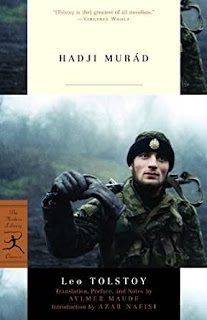
 In 1851 Leo Tolstoy enlisted in the Russian army and was sent to the Caucasus to help defeat the Chechens.  During this war a great Avar chieftain, Hadji Murad, broke with the Chechen leader Shamil and fled to the Russians for safety.  Months later, while attempting to rescue his family from Shamil's prison, Hadji Murad was pursued by those he had betrayed and, after fighting the most heroic battle of his life, was killed. Tolstoy, witness to many of the events leading to Hadji Murad's death, set down this story with painstaking accuracy to preserve for future generations the horror, nobility, and destruction inherent in war.  By and far, one of the best "anti-war" stories of the time. Also, what makes this such a great story is that Hadji Murad is a deeply complex human being with layer upon layer of nuance.